June 12, 2026
Industry InsightsThe 3:5:8 Rule for Flowers, Explained
The 3:5:8 rule is the proportion guide behind balanced arrangements. Here is what it means, how designers use it, and how a ratio becomes a stem list and a buy list.
Ask three florists what the 3:5:8 rule is and you'll get three slightly different answers, which tells you something: it's a guide, not a law. But it's a useful guide, and if you train new designers, price wedding work, or write recipes, it's worth being able to explain it in one breath.
What Is the 3:5:8 Rule?
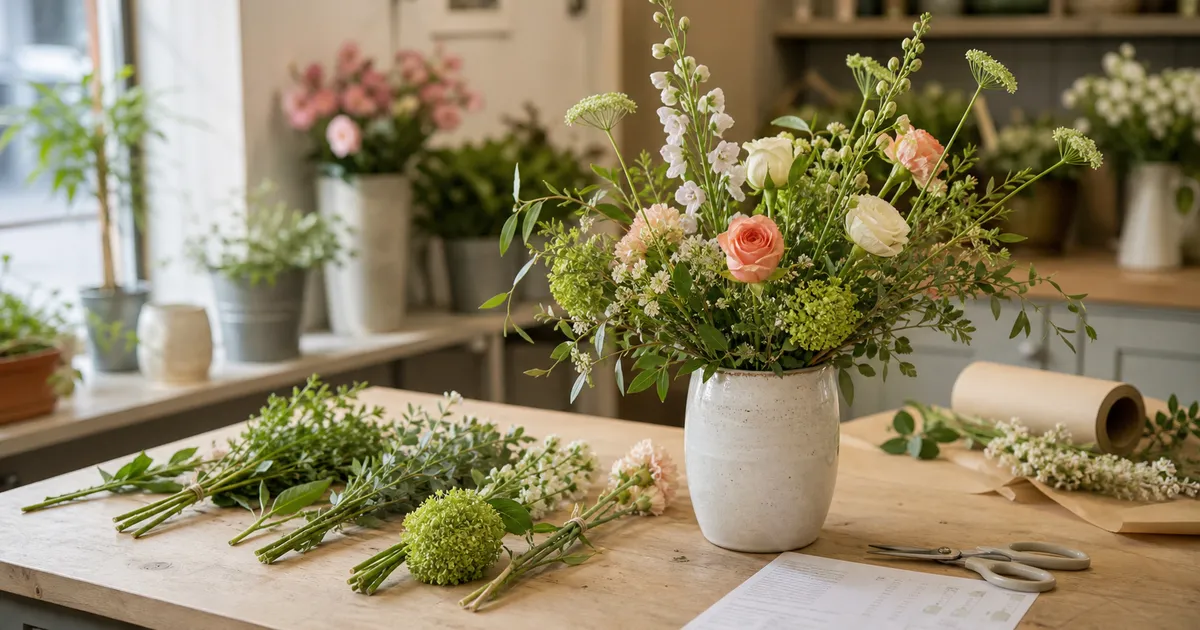
The 3:5:8 rule is a proportion guide for arrangements. Take the container as 3 parts. The flowers should rise about 5 parts above it. The whole piece, container and flowers together, comes to 8 parts. So the flowers stand a touch over one and a half times the height of the vase, and the finished arrangement is a touch under three times the container's height in total.
If those numbers feel familiar, they should. 3, 5 and 8 sit next to each other in the Fibonacci sequence, and the ratios between them (5 ÷ 3, 8 ÷ 5) land close to the golden ratio of roughly 1.6. The proportions that look "right" in a painting or a building are the same ones that make a vase arrangement look settled rather than squat or top-heavy.
A worked example. A 12cm vase: 12cm is your 3 parts, so one part is 4cm. The flowers rise about 5 parts, 20cm, above the rim. The whole piece stands around 32cm. Nobody is measuring this with a ruler on a busy Saturday, but the eye that says "that needs another couple of centimetres of height" is usually applying 3:5:8 without naming it.
How Working Designers Use It
In the workroom, the rule is most useful in three places.
Training. A new designer's early arrangements tend to be short and wide, because cutting stems long feels wasteful. Giving them 3:5:8 turns "make it taller" into something they can check themselves: vase height, times one and two-thirds, is where the top flowers should sit. It speeds up the stage where every piece needs a senior florist's once-over.
Consistency. If five designers make up the same £45 vase arrangement during Mother's Day week, the rule keeps them within sight of each other. The customer who ordered from the photo gets something the same shape as the photo.
Scaling up and down. The ratio holds at any size, which is why it matters for event work. A bud vase for a café table and a pedestal arrangement for a church both balance at roughly the same proportions; only the stem lengths and counts change. That makes it a handy sense-check when a couple asks you to "do the same but bigger" for the venue entrance.
And to be clear: plenty of beautiful work breaks the rule on purpose. A low, wide compote centrepiece ignores it entirely, because guests need to see each other across the table. Cascading bouquets run their own proportions. The rule is the default you deviate from knowingly, not a cage.
From Ratio to Recipe
Here's where the design rule meets the business. Proportions decide stem lengths, and stem lengths decide stem counts. A taller arrangement doesn't only need longer stems; it needs more of them to keep visual weight balanced through the middle and base. The moment you commit to "5 parts above a 3-part container", you've half-written the recipe: how many focal stems, how much line material to carry the height, how much foliage to cover the mechanics.
That's why experienced wedding florists write recipes per arrangement rather than guessing a lump sum. The recipe lists the stems, the foliage, the sundries and the labour minutes for each piece. Get the recipe right and the price protects your margin; get it wrong and you find out months later when you reconcile the books.
From Recipe to Stem List and Buy List
On a wedding with fifteen table centres, two pedestals, a bridal bouquet and six buttonholes, the maths multiplies fast. Each arrangement's recipe has to roll up into one stem list for the whole job, grouped by variety and colour, so you can order from the wholesaler in one go.
Doing that by hand is an evening of counting and re-counting. This is the part software should carry. In Digital Florists Events, every arrangement has its own recipe, the live cost and margin update as you design, and when the event is finalised the buy list is generated for you, by stem and by colour. The 3:5:8 judgement stays where it belongs, in the designer's head and hands. The counting, costing and aggregating moves to the system.
One honest note: no software applies the 3:5:8 rule for you, and ours doesn't claim to. Proportion is a design decision made by a florist looking at a container, a venue and a brief. What the software does is make sure the decision you made is priced properly and bought accurately.
Quick Answers
Is the 3:5:8 rule the same as the golden ratio?
Close cousin rather than identical twin. 3, 5 and 8 are consecutive Fibonacci numbers, and the ratios between them approximate the golden ratio (about 1.618). For practical floristry the difference doesn't matter; the rule is the workable, countable version.
Do I have to follow it?
No. It's a starting point that makes arrangements look balanced by default. Low centrepieces, cascades and contemporary asymmetric work all break it deliberately. Break it on purpose, not by accident.
Does the rule apply to width as well as height?
It can. For low, horizontal designs many florists flip the same proportions sideways: the arrangement spreads about 5 parts across a 3-part container. Same ratio, rotated 90 degrees.
Where does software fit in?
After the design decision. Once you know each arrangement's shape and size, recipes turn that into stems, costs and margin, and the buy list rolls every recipe up when the event is finalised. If you run weddings and events alongside shop work, see how that fits together in Digital Florists Events and our guide for wedding and event florists.
If You Price This Work for a Shop
The ratio is the easy half. The hard half is fifteen table centres, two pedestals and six buttonholes turning into one stem list without an evening of counting. In Digital Florists Events each arrangement keeps its own recipe, the cost and margin update as you design, and the buy list rolls up by stem and by colour when the event is finalised. It's £75/mo per shop. The 30-day no-card trial is long enough to price a real wedding in it before you pay anything.
Written by
Digital Florists Team



See It in Your Shop
Book a demo and we'll walk through Digital Florists with your shop in mind.
After the demo, choose whether and when we set up your 30-day no-card trial.