February 3, 2026
Delivery & LogisticsRoute Planning for Florists: Cut Costs Without Cutting Corners
Manual route planning costs hours and thousands in fuel. Here is how automated routing saves money while improving delivery reliability.
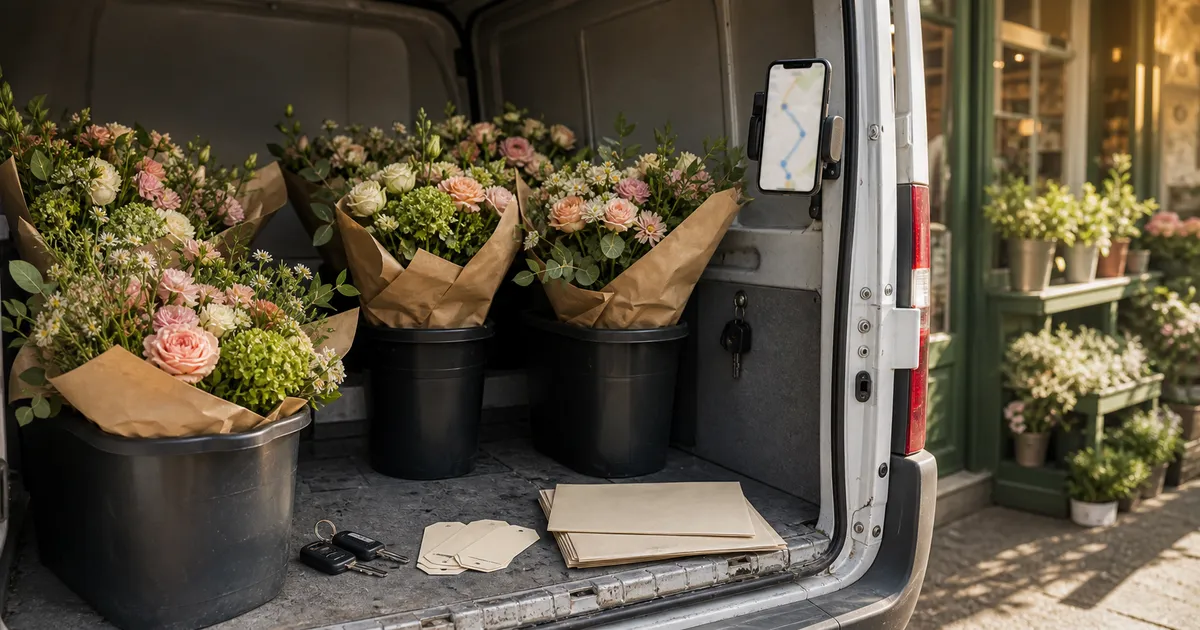
It's 7am. Someone in your shop is bent over a stack of delivery tickets, squinting at a dog-eared map (or more likely Google Maps on a phone), trying to stitch together something that vaguely resembles a sensible route. The drivers are loitering by the back door by quarter past eight. By nine, you've got a plan that's maybe 70% efficient.
On a good day.
This plays out in flower shops across the country every single morning. And it costs far more than most people ever sit down and calculate.
The Daily Routing Challenge
Routing flowers is nothing like delivering pizzas. A pizza goes from one shop to a nearby house in twenty minutes. Flower deliveries? Completely different beast:
- Dozens of stops flung across a wide delivery area
- Rigid time windows. Funerals that can't be a minute late, hospital visiting hours, the dreaded "must arrive before 2pm"
- Some drops take 90 seconds at a doorstep, others need half an hour because you're dressing a venue
- Then someone phones in a last-minute order at half ten and throws the whole morning off
Nobody, however many years they've been doing it, can mentally juggle all of that the way a computer can. Our brains aren't built for that kind of optimisation.
Hidden Costs of Manual Planning
Time Spent Planning
Most shops burn somewhere between 30 and 90 minutes on route planning every morning. Doesn't sound catastrophic, does it? Add it up over a year though. That's 130 to 390 hours gone.
At £20 an hour, you're looking at £2,600 to £7,800 annually, all of it spent deciding which order to visit addresses in. Meanwhile nobody's serving walk-ins, nobody's in the workroom making arrangements, and nothing that grows the business is getting any attention.
Inefficient Routes Mean Higher Fuel Costs
Even your best planner, the one who's been doing it for fifteen years and knows every back road, produces routes that are 15-25% longer than they need to be. We're human. We can't crunch that many variables at once.
For a shop running two drivers at 50 miles each per day, the maths is pretty grim:
- Total daily driving: 100 miles (160km)
- 20% inefficiency: that's 20 extra miles (32km) every single day
- Over a year: 5,200 wasted miles (8,320km)
- At £0.24 per mile in fuel: £1,248 burned for absolutely nothing
And that's only fuel. Factor in wear on the van and it gets worse. That's your money literally driving round in circles.
Driver Stress and Turnover
Ask any delivery driver what really winds them up. Nine times out of ten, it's passing an address knowing they'll have to loop back to it later because the route has them going somewhere else first. Bad routes grind people down. The frustration builds, burnout follows, and eventually they hand in their notice.
Replacing a driver isn't cheap either. Recruitment, training, weeks of reduced productivity while the new person learns the run. A small routing improvement can genuinely be the difference between keeping a good driver and watching them walk out the door.
Late Deliveries and Customer Complaints
Badly planned routes mean late deliveries. Late deliveries mean complaints, refunds, and customers who quietly disappear and never come back.
But here's the one that really stings. A late funeral delivery. Or flowers turning up after the wedding ceremony's already finished. No discount code in the world fixes that. That kind of failure sticks to your reputation for years.
How Automated Routing Works
Routing software takes every variable your planner wrestles with each morning and processes the lot. In seconds.
What the Software Considers
- Addresses: exact GPS coordinates for every single stop
- Time windows: when each delivery absolutely has to arrive
- Traffic patterns: live conditions layered with historical data for that time of day
- Driver schedules: who starts when, finish times, break requirements
- Stop duration: a quick doorstep drop versus a 30-minute hotel setup
- Priority levels: flagging the ones that cannot, under any circumstances, be late
It evaluates thousands of possible combinations and ranks them. The best route shows up on screen in seconds, not the 45 minutes it took your planner with a highlighter and a printout.
The Process
- Import orders: pulled directly from your order management system
- Set parameters: how many drivers, start times, any hard constraints
- Optimise: one click and the routes are calculated
- Review: cast your eye over anything that needs a human judgement call
- Send to drivers: routes go straight to their phones
- Track progress: watch deliveries happening in real time
Five to ten minutes, the whole lot. Compare that to the frantic morning scramble you're dealing with now.
Key Features to Look For
Time Window Support
Non-negotiable for florists. If the software can't handle "deliver before 2pm" or "between 10am and noon" as hard constraints, it's useless to you. Walk away.
Multi-Stop Optimisation
Some tools only optimise one journey at a time. Not good enough. You need software that looks at all 20 or 30 deliveries together and works out the best overall sequence, not the best next stop from wherever you happen to be.
Real-Time Traffic
A route that looks perfect at 7am can fall apart completely when there's a lorry jackknifed on the A1 at half nine. Good software pulls in live traffic data and adjusts on the fly. That matters.
Driver Mobile App
Even the most perfectly optimised route in the world is worthless if your driver can't follow it. They need an app on their phone: turn-by-turn navigation, delivery details, one-tap status updates so the shop knows exactly what's happening out on the road.
Easy Re-Optimisation
Rush orders come in. A driver rings in sick. Someone adds three deliveries at 11am that weren't there at half eight. The system needs to handle all of that without making you tear the whole plan up and start again.
Integration With Order Management
If you're copying and pasting addresses between systems, you've already lost most of the benefit. Your routing tool should pull orders straight from wherever you manage them: no manual steps, no re-keying, no room for typos. This is exactly why our delivery software builds routing directly on top of your order data.
Real Savings Calculation
Here's what the numbers look like for a typical UK or Irish florist.
Assumptions
- 2 drivers, each doing about 15 deliveries a day
- Average daily distance: 50 miles (80km) per driver, 100 miles (160km) total
- Current route efficiency: around 75% (meaning 25% waste)
- Planning time: 45 minutes every morning
- Fuel cost: £0.24 per mile
- Labour cost: £20 per hour
Savings With Automated Routing
- Planning time: 45 minutes down to 10, that's 35 minutes saved daily
- Annual planning savings: 35 min x 260 working days = 152 hours = £3,040
- Route efficiency: jumps from 75% to around 90%, 15% less distance driven
- Distance saved: 100 miles (160km) x 15% = 15 miles (24km) per day
- Annual fuel savings: 15 miles x 260 days x £0.24 = £936
Total annual savings: £3,976
That's the conservative figure. It doesn't account for reduced van wear, fewer drivers quitting on you, or fewer refunds from late deliveries. The real number is higher.
Making the Transition
Switching over is easier than most people expect. Genuinely. It's not the upheaval you might be imagining.
Week 1: Learn the System
Run your deliveries through the software, but stick with your normal manual routes as the real plan. Compare them side by side. Most shops spot the difference straight away, and seeing it with your own eyes builds confidence quickly.
Week 2: Parallel Run
Start following the automated routes for real, but have your experienced planner review them first. Notice where the software nails it, and where a bit of human judgement adds something. Tweak as you go.
Week 3 Onwards: Trust the System
By now the pattern is obvious. The software builds the routes. Your job shifts to reviewing the odd exception rather than building every route from scratch each morning. It's a completely different way of working.
Common Concerns
"My drivers know the area better than any software."
They probably do. They know which roads are murder for parking and which care home has that awkward side entrance you'd never find on a map. That knowledge genuinely matters. But it doesn't help anyone sequence 30 stops against live traffic and delivery windows simultaneously. So use both. Let the software figure out the order, let drivers apply their street knowledge on the ground.
"What if the software gets it wrong?"
It will. Sometimes. Nothing's perfect. But it gets things right far more consistently than manual planning, and you can always override individual decisions when something looks off. That option never goes away.
"My team will resist the change."
Drivers tend to come around fast. Less driving, less stress, finishing earlier. Hard to argue with any of that, really. The pushback usually comes from whoever currently owns the planning process. Understandable. But honestly, that person's skills are better deployed elsewhere in the business.
Where Does This Leave You?
Manual route planning made sense when there wasn't a realistic alternative. Now there is, and the savings pay for the software many times over.
Every morning spent shuffling delivery tickets by hand is a morning not spent growing your business. Every wasted mile is money going nowhere useful.
The question isn't really whether automated routing makes sense for your shop. It's what's been stopping you.
Ready to ditch the manual route planning? Book a demo and see how Digital Florists Deliveries includes smart routing that cuts costs without cutting corners.
Written by
Digital Florists Team
See it in your shop
Book a demo and we'll walk through Digital Florists with your shop in mind.
After the demo, choose whether and when we set up your 30-day no-card trial.